How to Write a Resume That Gets Interviews in 2026
Landing an interview has become quite tough these days as there are hundreds of candidates applying for the same job. In fact, many qualified job seekers are instantly rejected simply because their resumes are not professionally written and do not follow ATS guidelines.
So, now you not only have to impress the recruiter to get an interview, but also pass ATS to get shortlisted. According to Jobscan, 97.8% of Fortune 500 companies use Applicant Tracking Systems (ATS) to screen resumes before recruiters review them. That's why an ATS-friendly resume is essential in today's hiring process.
Writing a professional resume is not quite that hard, and you can do it on your own if you know some basics.
That’s what we have covered in this blog. Read this blog to learn how to write a resume that passes ATS screening, grabs a recruiter's attention,
What Employers Look for in a Resume
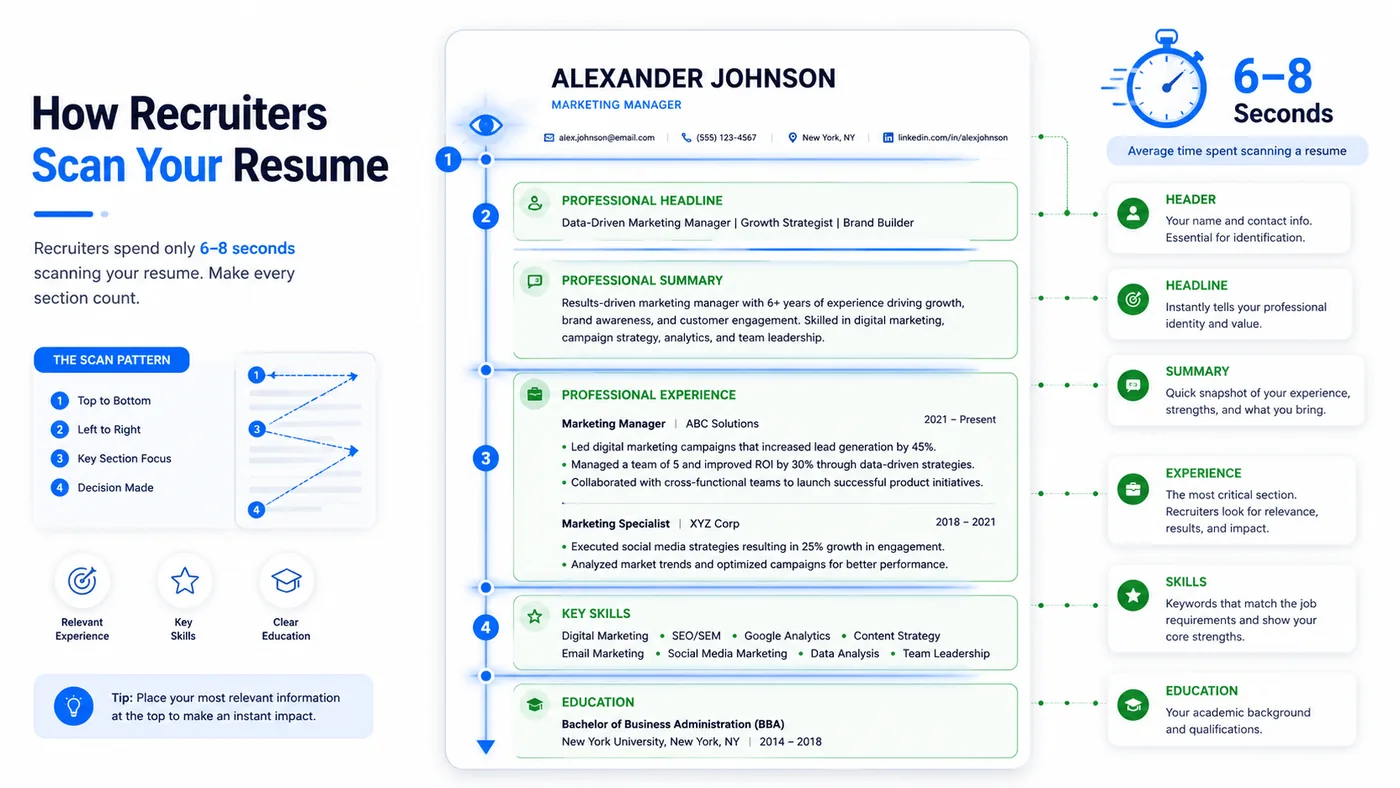
Let me be real with you: recruiters don't spend much time on your resume. They scan it fast. They're looking for specific things in a specific order.
First, they look at your headline and summary. Can they quickly understand what you do? If yes, they keep reading. If no, they move on.
Then they scan your most recent jobs. Did you accomplish anything? Do the skills match what they need?
A professional resume should immediately answer three questions:
- Are you qualified?
- Have you achieved measurable results?
- Are you relevant for this specific job?
That's basically it. If those first few things don't answer their question, they don't read deeper.
Whether you're applying for jobs in India, Dubai, the UK, the US, or anywhere else, recruiters value resumes that are tailored to the role, easy to read, and backed by measurable achievements.
What Gets You Read
Recruiters are looking for proof that you did something valuable. Not a list of responsibilities. Proof.
"Managed a team of 5 people" = boring, expected.
"Led team of 5 that increased sales by 35%, generating $250k extra revenue" = interesting, specific, proves you delivered.
One shows you had a job. The other shows you made an impact. There's a huge difference.
What Is an ATS Resume?
Here's something people worry about: "Will a robot even read my resume?"
Yes. About 8 out of 10 companies now use AI systems to screen resumes. These systems aren't evil. They're just trying to match your resume to the job description.
They look for: Can you do the job? Do you have the skills they listed? Do you have relevant experience?
So the best strategy is simple: Make sure your resume is clearly ATS-ready.
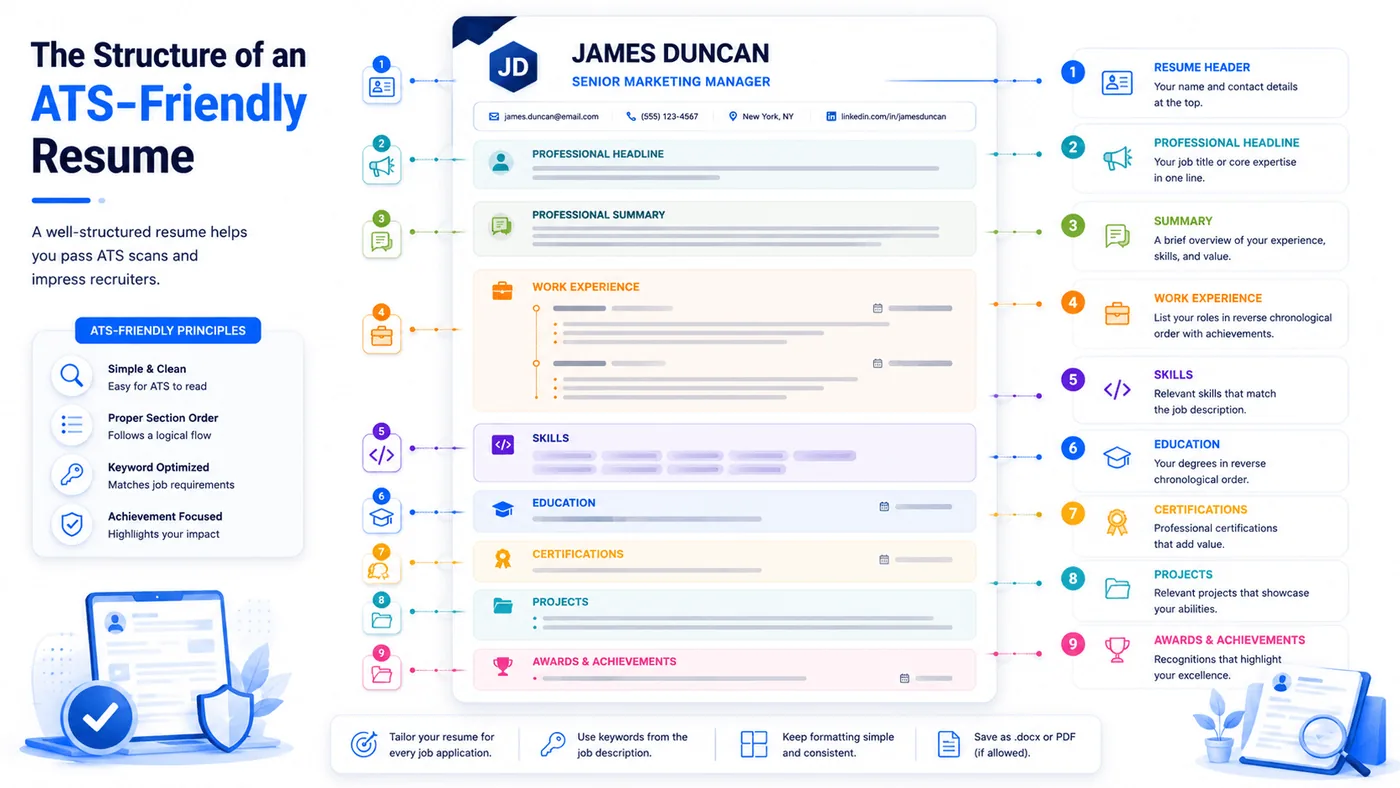
An ATS resume is a resume designed to be easily read by an Applicant Tracking System before it reaches a recruiter. Many employers receive hundreds or even thousands of applications for a single position, so ATS software helps them organise, filter, and rank candidates based on the job description.
How ATS Software Screens Resumes
Before a recruiter reviews your application, ATS software evaluates your resume against the job requirements. It typically checks:
- Relevant keywords from the job description.
- Job titles that match the position.
- Technical and soft skills required for the role.
- Years of experience in similar positions.
- Education and required qualifications.
- Certifications or licenses requested by the employer.
- Resume formatting that the system can read accurately.
Why ATS-Friendly Resumes Get More Interviews
An ATS-friendly resume improves your chances of reaching a recruiter by making your resume easier for software to shortlist. Instead of relying on design or graphics, it focuses on keywords, relevance, and job-specific information.
Better Keyword Matching
Including relevant keywords from the job description helps ATS software identify your resume as a stronger match for the role. This increases your chances of being shortlisted.
Improved Resume Shortlisting
Simple formatting, standard headings, and clean layouts resume allow ATS systems to read your information correctly without missing important experience, skills, or qualifications.
Higher Performance Visibility
When your resume matches the employer's requirements, ATS software is more likely to rank it higher, giving recruiters a better chance of reviewing your application.
Better Success Across Global Job Markets:
Whether you're applying in India, Dubai, the UAE, the UK, the US, Canada, or Australia, an ATS-friendly resume follows hiring best practices used by employers around the world.
How to Write a Professional Resume Step by Step
Writing a professional resume is easier when you break it into sections. Every part of your resume is important, from introducing yourself to showcasing your experience and skills.
Follow these steps to create an ATS-friendly resume that looks professional and improves your chances of getting interviews.
Step 1: Choose the Best Resume Format
The right resume format helps recruiters quickly understand your experience and career progression. It also makes your resume easier for ATS software to read.
Reverse Chronological Resume: This is the most widely accepted and recruiter-preferred resume format. It lists your most recent job first and works well for professionals with consistent work experience.
Best for:
- Experienced professionals
- Career growth
- Corporate jobs
- International job applications
Functional Resume: A functional resume focuses on skills instead of work history. While it can help candidates with employment gaps or career changes, many recruiters prefer chronological resumes because they show career progression more clearly.
Best for:
- Career changers
- Fresh graduates with limited experience
- Professionals returning to work
Combination Resume: A combination resume highlights both skills and work experience. It starts with a strong skills section before detailing your employment history.
Best for:
- Technical professionals
- Senior-level candidates
- Specialists with diverse experience
Which Resume Format Is Best?
For most job seekers, the reverse chronological resume remains the best choice. A reverse chronological resume is especially best for candidates targeting jobs in Dubai, UAE, UK, USA, Saudi Arabia, etc
Step 2: Write a Professional Resume Headline
Your resume header is the first thing recruiters notice. It should make it easy for employers to identify you and contact you quickly.
Include:
- Full Name
- Professional Job Title
- Mobile Number
- Professional Email Address
- LinkedIn Profile
- Portfolio or Website (if relevant)
- Current City and Country
- Visa Status (if applicable)
Avoid adding unnecessary details like marital status, religion, passport number, or full home address unless specifically requested.
Formula: Job Title + Core Expertise + Years of Experience
Good Examples
✔️ Software Engineer | Java & Spring Boot | 5+ Years of Experience
✔️ HR Manager | Talent Acquisition & Employee Relations | 8+ Years
✔️ Graphic Designer | Branding, UI/UX & Motion Graphics | 4+ Years
Step 3: Write a Powerful Resume Summary
Your resume summary is one of the most important sections. In just a few lines, it should explain who you are, what you've achieved, and why you're a strong fit for the role.
It should answer one question: Why should this company interview you?
Keep it between 3–5 lines and focus on. Include this:
- Years of experience
- Industry or specialization
- Core skills
- Biggest achievement
- Career value
Resume Summary Formula: Experience + Expertise + Achievement + Skills + Value
Example
Results-driven Sales Manager with 8+ years of experience leading high-performing teams across the retail industry. Increased annual revenue by 35%, managed key client accounts, and consistently exceeded sales targets. Skilled in business development, team leadership, and customer relationship management.
Step 4: Add Work Experience That Shows Results
Your work experience section is what will help you pass the ATS and make the recruiter decide how capable you are. Don't simply list your responsibilities. Show what you achieved.
Include this:
- Job Title
- Company Name
- Employment Duration
- Location
- 3–6 achievement-focused bullet
Achievement Formula: Action Verb + Task + Measurable Result
Good Example
Digital Marketing Executive
ABC Technologies | Dubai, UAE
Jan 2023 – Present
- Increased organic website traffic by 120% through SEO and content optimization.
- Reduced Google Ads cost per lead by 35% while improving conversions.
- Managed email campaigns with an average 42% open rate.
- Worked with the design team to launch campaigns that generated over 1,500 qualified leads.
Instead of this:❌ Managed customer service team.
Whenever possible, include measurable achievements such as:
- Revenue generated
- Costs reduced
- Time saved
- Projects completed
- Teams managed
- Customer satisfaction improvements
Numbers make your accomplishments more credible.
Step 5: Add Relevant Skills
Your skills section should support your experience, not repeat it. Include a mix of technical and workplace skills that match the job description. The skills section helps recruiters and ATS software quickly identify whether you match the job requirements.
How to Choose the Right Skills
- Read the job description carefully.
- Highlight the skills that appear multiple times.
- Include only the skills you genuinely have and can demonstrate during an interview.
For example,
Technical Skills
- Microsoft Excel
- SQL
- AutoCAD
- Adobe Photoshop
- Google Analytics
- Salesforce
Professional Skills
- Leadership
- Problem Solving
- Communication
- Team Management
- Project Management
- Time Management
Pro Tip: Place the most relevant skills near the top of the list so recruiters notice them immediately.
Step 6: Include Education
Your education section confirms your academic qualifications. Keep it clean, easy to read, and relevant to your career stage. If you're an experienced professional, keep this section brief. Fresh graduates can add more academic details.
Mention:
- Degree
- University or Institution
- Graduation Year
- Relevant Honors (Optional)
Fresh graduates can also include:
- Academic projects
- Relevant coursework
- Internships
- Research work
Experienced professionals should keep this section brief and allow work experience to take priority.
Example:
Bachelor of Computer Science
University of Delhi- 2022. CGPA: 8.6/10
Relevant Coursework:
- Data Structures
- Database Management
- Software Engineering
Pro Tip: If you're applying for international jobs, mention the full university name instead of abbreviations.
Step 7: Add Certifications
Professional certifications show your commitment to continuous learning. They also strengthen your resume, especially when applying for specialized roles. They are especially valuable for technical, finance, marketing, IT, HR, and project management roles.
What to include:
- Certification Name
- Issuing Organization
- Completion Year
Example:
- Google Data Analytics Professional Certificate. Goog. 2025
- Project Management Professional (PMP). Project Management Institute. 2024
Popular Certifications
- Google Professional Certificates
- AWS Certifications
- Microsoft Certifications
- PMP
- HubSpot Certifications
- Cisco Certifications
- IELTS (where relevant)
Pro Tip: Only include certifications that support the job you're applying for.
Step 8: Include Projects, Awards & Achievements
This section helps differentiate you from other candidates with similar experience. Projects and achievements help you stand out from candidates with similar qualifications. They give recruiters additional evidence of your skills and accomplishments.
This section is particularly useful for freshers, career changers, freelancers, and technical professionals.
What to Include
- Project Name
- Your Role
- Technologies or Skills Used
- Measurable Outcome
Good Example
E-commerce Website Migration
Led the migration of over 5,000 product listings to Shopify while maintaining SEO rankings.
Reduced migration time by 40% and improved website performance after launch.
Achievement Example
🏆 Employee of the Year – 2024
Recognized for exceeding annual sales targets by 32% and mentoring new team members.
Pro Tip: Even personal projects can strengthen your resume if they demonstrate relevant skills and measurable results.
Resume Writing Tips That Help You Get More Interviews
Writing a good resume is one thing. Writing a resume that consistently gets shortlisted is another. The difference comes down to small details.
These resume writing tips will help you create a professional, ATS-friendly resume that gets shortlisted.
Customize Your Resume for Every Job
Sending the same resume to every employer is one of the biggest reasons candidates don't get interview calls. Every company looks for different skills, keywords, and experience. A tailored resume shows recruiters that your experience matches the role. It also increases your chances of passing ATS screening.
How to Do It
- Read the job description carefully.
- Identify important skills and keywords.
- Update your resume summary and headline.
- Prioritize relevant achievements.
- Remove information that isn't relevant.
Use Numbers Instead of Responsibilities
Recruiters are more interested in results than responsibilities. Instead of saying what you were responsible for, show what you accomplished.
Instead of Writing
- Managed customer support team.
- Responsible for inventory.
- Worked on digital marketing.
Write Like This
- Managed a team of 18 customer support executives, improving customer satisfaction by 30%.
- Reduced inventory discrepancies by 22% through process improvements.
- Increased website traffic by 145% through SEO and content optimization.
Match Keywords From the Job Description
Most employers use ATS software before recruiters review resumes. If your resume doesn't include relevant keywords, it may never reach a hiring manager.
How to Find Keywords: Look for repeated words in the job description, such as: project Management, customer service, Salesforce, budget planning, and data Analysis.
Include these keywords naturally throughout your:
- Resume Headline
- Summary
- Work Experience
- Skills Section
Remember: Never add keywords you don't actually have experience with.
Keep Your Resume Updated
Your resume shouldn't only be updated when you're actively looking for a new job. Make it a habit to update it whenever you complete a major project, earn a certification, receive a promotion, learn a new skill, or achieve measurable results.
This ensures you're always ready for new opportunities.
Keep Your Resume Easy to Scan
Recruiters don't read every word immediately. They scan your resume looking for the most important information.
Follow this:
- Use clear headings.
- Keep paragraphs short.
- Use bullet points.
- Leave enough white space.
- Use one professional font.
- Maintain consistent formatting.
A clean layout makes your resume look more professional and improves readability.
Use Strong Action Verbs
Every bullet point should begin with a powerful action verb. Instead of passive language, use words that demonstrate ownership and impact.
Examples: Increased, Led. Managed, Improved, Reduced, Implemented, Developed, Designed, Generated and Optimised.
These words immediately make your achievements sound stronger.
Resume Mistakes to Avoid
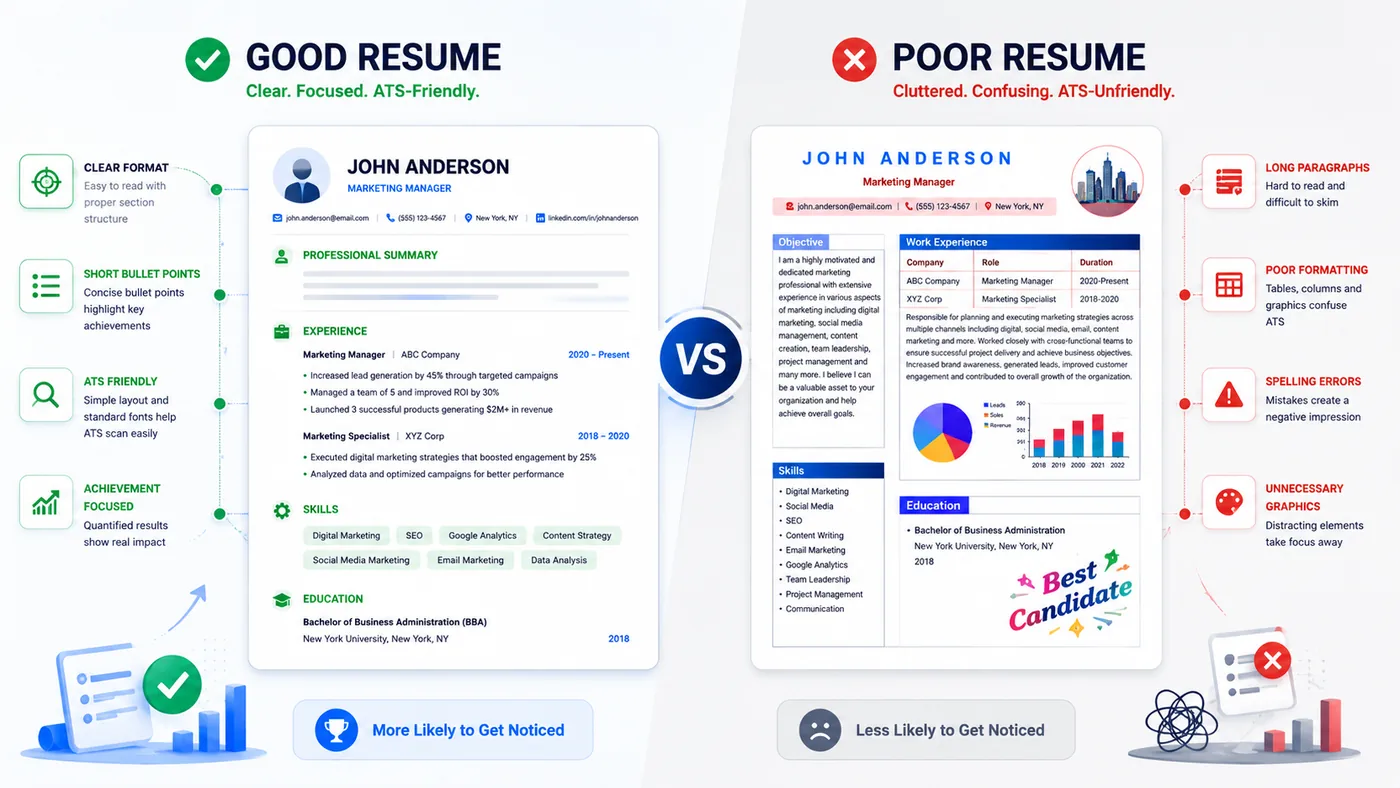
Even highly qualified candidates lose interview opportunities because of avoidable resume mistakes. Avoiding these common errors can significantly improve your chances of getting shortlisted.
- Writing Long Paragraphs: Recruiters don't have time to read large blocks of text. Keep paragraphs short and use bullet points to make your achievements easier to scan.
- Adding Irrelevant Information: Avoid including outdated experience, unrelated hobbies, personal details, or unnecessary information that doesn't support your application.
- Ignoring ATS Keywords: Even a well-designed resume may be rejected if it doesn't include relevant keywords from the job description. Always review the job posting before applying.
- Spelling & Grammar Mistakes: Simple mistakes can make your resume appear rushed and unprofessional. Proofread carefully and consider asking someone else to review it before submitting.
- Poor Resume Design: A resume doesn't need fancy graphics to stand out. Choose a clean, professional layout that's easy for both recruiters and ATS software to read.
Should You Use a Resume Template or Hire Professional Resume Writers?
A resume template can help you organise your information, but it doesn't guarantee that your resume will impress recruiters or pass ATS screening.
A professionally written resume goes beyond formatting. It helps you pass the ATS filter and impress the recruiter. It highlights your achievements, uses the right keywords, presents your experience, and aligns your resume with current hiring practices.
When You Should Hire Professional Resume Writers
You should consider professional resume writing services if:
- You're not getting interview calls despite applying regularly.
- You're changing industries or careers.
- You're applying for jobs in Dubai, the UAE, the UK, Canada, Australia, or the US.
- You're targeting senior or leadership positions.
- You're unsure how to optimize your resume for ATS.
- You struggle to highlight your achievements effectively.
- You want a recruiter-ready resume that reflects your experience professionally.
A professional resume writer doesn't change your experience; they help present it clearly, strategically, and in a way that aligns with modern hiring expectations.
Resume Checklist Before You Apply
Before you click Apply, take a few minutes to review your resume. A final quality check can help you catch mistakes that may cost you an interview.
Use this checklist every time you apply for a new job.
Content Checklist
- Resume is customized for the job.
- Resume headline matches the position.
- Summary highlights relevant experience.
- Work experience focuses on achievements, not responsibilities.
- Skills match the job description.
- Certifications and projects are updated.
ATS Checklist
- Uses standard section headings.
- Includes relevant keywords naturally.
- No tables, graphics, or text boxes.
- Easy for ATS software to read.
- Saved in the requested format (PDF or Word).
Recruiter Checklist
- No spelling or grammar mistakes.
- Professional email address.
- Contact information is correct.
- Formatting is consistent.
- Resume looks clean and easy to scan.
Need a Resume That Gets Interviews?
If you are struggling to get interviews, it’s a sign that you need a new professionally written ATS resume.
At Enhance Resume, every resume is written by experienced resume writers who understand what recruiters look for and how modern ATS software evaluates resumes.
Whether you're a fresher, an experienced professional, a manager, or an executive, we create resumes that clearly present your skills, achievements, and experience while following current hiring best practices.
Ready for a New Resume That Will Get You Interviews?
Your resume is often your first opportunity to make a strong impression. Make sure it reflects your experience, achievements, and career potential in the best possible way.
FAQs
How do I write a resume for my first job?
To write a resume for your first job, focus on your education, internships, academic projects, and certifications. You can add volunteer work, extracurricular activities, and transferable skills in your resume. Even without full-time experience, you can demonstrate your potential by highlighting relevant achievements and responsibilities.
What is the best resume format in 2026?
The reverse chronological resume format remains the best resume format in 2026 for most professionals. It's easy for recruiters to read and works well with ATS software. It clearly shows your career progression.
How long should a resume be?
For most professionals, a one- to two-page resume is ideal. Fresh graduates should usually keep it to one page. While experienced professionals with extensive experience may use two pages if every section adds value.
Should I include a photo on my resume?
It depends on the country and employer. In countries like the US, UK, Canada, and Australia, photos are generally not recommended. However, some employers in regions such as the Middle East may request them. Always follow local hiring practices and the employer's instructions.
Is PDF or Word better for resumes?
If the employer doesn't specify a format, PDF is usually the best option because it preserves your formatting across devices. If a job posting specifically requests a Word document, always follow those instructions.
Can AI write a good resume?
AI tools can help generate ideas, improve wording, or suggest structure. However, an effective resume should reflect your unique experience, achievements, and career goals. You can write it yourself, and take help from professional resume writing services like Enhance resume.
What skills should I include on my resume?
You can include skills that are relevant to the position you're applying for. A strong resume usually combines technical skills, industry-specific knowledge, software proficiency, and workplace skills. You can add skills such as communication, leadership, and problem-solving.
How often should I update my resume?
Review your resume every three to six months, even if you're not actively job hunting. Update it whenever you complete a major project, receive a promotion or earn a certification. Update it when you learn a new skill or achieve measurable results. Keeping your resume current saves time when new opportunities arise.
← Back to all articles