Why ATS Rejects Your Resume: 12 Mistakes You Need to Avoid
Your resume can be rejected by an ATS before a recruiter ever sees it.
You applied to a job thinking you had all the skills and experience required. You were sure you were the best candidate. But still, your resume got rejected.
One of the major reasons behind it could be ATS. An Applicant Tracking System (ATS) helps employers manage job applications. It scans resumes for skills, keywords, job titles, qualifications, and experience.
And if your resume is not ATS-friendly, it could automatically reject it. So, why do ATSs reject some resumes?
It could be missing keywords. It could be missing skills. It could be unclear headings. It could even be a generic resume that doesn't match the job.
The good news is that these problems can be fixed.
Read this blog to learn the most common ATS resume mistakes and show you how to avoid them. You'll also learn how to create an ATS-friendly resume that makes your skills and experience easier for recruiters to find.
What Is an Applicant Tracking System (ATS)?
An Applicant Tracking System (ATS) is recruitment software that helps employers collect, organize, and manage job applications. Basically, instead of reviewing every resume manually, recruiters use ATS to sort applications, search for specific skills, and quickly identify candidates who match the job description.
Businesses of all sizes, from startups to global corporations, use ATS software to shortlist applications efficiently. When a single job posting receives hundreds of applications, an ATS helps recruiters find the most relevant candidates without spending hours reviewing every resume.
Here's what typically happens after you submit your application:
- Your resume is uploaded into the ATS.
- The ATS software extracts information such as your work experience, education, skills, certifications, and contact details.
- It compares your resume with the job description.
- Recruiters use the ATS to search, filter, and rank candidates based on the qualifications they're looking for.
- The most relevant resumes are usually reviewed first.
This is why your resume needs to be more than visually appealing. It also needs to be structured so that hiring software can read and interpret it correctly.
How Does an ATS Read Your Resume?
An ATS doesn't read your resume the way a person does. It scans the document for important information such as:
- Job titles
- Relevant skills
- Industry keywords
- Work experience
- Education
- Certifications
- Dates of employment
- Contact information
If your resume uses complicated formatting, graphics, tables, or unusual section headings, the software may struggle to understand your information accurately.
Think of an ATS as a search engine for resumes. The clearer and more relevant your resume is, the easier it becomes for recruiters to find you.
Does ATS Really Reject Resumes?
One of the biggest myths about hiring software is that ATS automatically rejects resumes. The truth is a little different.
An ATS doesn't usually "reject" resumes on its own. Instead, it organizes applications, identifies relevant keywords, and helps recruiters prioritize candidates who best match the job requirements.
Imagine a company receives 500 applications for a single position.
A recruiter simply doesn't have enough time to review every resume in detail. Instead, they search the ATS using keywords such as:
- Project Management
- Java
- CPA
- Digital Marketing
- Salesforce
- Data Analysis
Think of the ATS as a filter. It looks for resumes that match the job, helping recruiters find the most relevant candidates faster. In other words, the ATS isn't deciding that you're unqualified. It's simply making it harder for recruiters to find your resume.
12 Reasons ATS May Reject or Overlook Your Resume & How to Fix Them
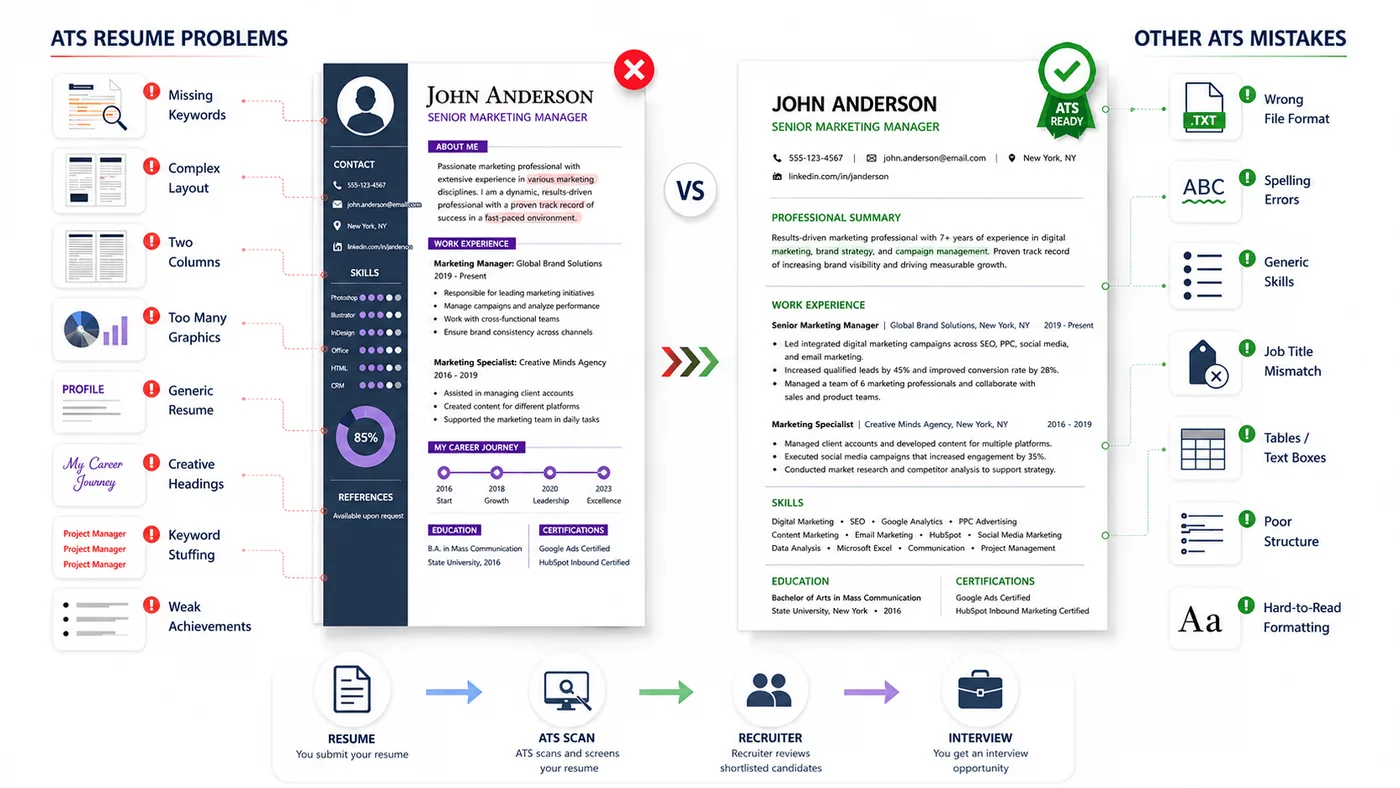
Now that you know how ATS works, let's get to the part that matters most.
Why might your resume fail to make it in front of a recruiter?
The answer isn't always your experience. Sometimes, it's how your resume presents that experience.
Here are the most common ATS resume mistakes to check before your next application.
1. You're Missing Important Keywords
So, what exactly is a resume keyword?
A keyword is a word or phrase in a job description that describes the skills, experience, qualifications, or tools the employer wants.
For example, a digital marketing job might require expertise in SEO, Google Analytics, HubSpot, content marketing, and paid advertising. These are keywords for that particular job.
Look at the job description before you send your resume.
What skills does the company mention? What software do they want you to know? What experience do they ask for?
These are the words you should look for in your own resume. Don't add skills you don't have. And don't copy the whole job description. Just make sure the important skills you already have are easy to find.
2. Your Resume Is Too Complicated
Some resumes try too hard to look different. They use sidebars, text boxes, graphics, tables, and unusual layouts. These designs may look good on your screen, but an ATS may not read them properly.
For most jobs, you don't need a complicated design. Use a clean ATS resume layout with clear headings and simple formatting. Make your experience easy to find. Your resume should look professional, not complicated.
3. You're Using Two Columns
Two-column resumes look neat. The problem is that an ATS may read the columns in the wrong order.
For example, it might read your skills first, then jump to another section before reading your work experience. This can make your resume harder for the system to understand.
A single-column resume avoids this problem.
Keep your information in a simple order:
Contact Information → Summary → Work Experience → Skills → Education
It's easier for recruiters to scan too.
4. Your Resume Has Too Many Graphics
A few design elements won't make your resume better. Photos, icons, logos, charts, and skill bars can take attention away from your actual experience. Some of these elements can also be difficult for an ATS to read.
Take a skills chart as an example.
Excel █████████ 90%
It looks nice, but it doesn't clearly tell the ATS what your skill level means.
Instead, write: Microsoft Excel - Advanced
That's all you need. Keep the important information in words. Your skills and achievements matter more than decoration.
5. You're Sending the Same Resume Everywhere
Sending the same resume for every job application can hurt your chances. Every job description is different. Even when two companies are hiring for the same position, they may want different skills, experience, or qualifications.
Your resume should match what each employer is looking for. This helps the ATS find the right keywords and helps the recruiter quickly see why you're a good fit for the role.
- Start by reading the job description before applying.
- Look at the required skills, tools, responsibilities, and qualifications.
- Then update the relevant parts of your resume to match your experience with those requirements.
- You don't need to rewrite your entire resume every time.
- You may only need to update your Professional Summary, Skills, keywords, and a few work experience points.
For example, one Marketing Manager job may focus on SEO and content marketing, while another may require Google Ads and lead generation. Your resume should highlight the experience that matches each role.
6. Your Section Headings Are Too Creative
Your resume headings should be easy to understand. ATS software looks for common headings to identify different parts of your resume. Recruiters also expect to see familiar sections when they open your resume.
Use headings such as:
- Professional Summary
- Work Experience
- Skills
- Education
- Certifications
- Projects
Avoid headings like "My Career Journey" for your work experience or "What I Bring" for your skills.
These may sound creative, but they can make your resume harder to understand.
7. Your Job Titles Don't Match the Role
Another reason why ATS might be rejecting your resume could be an incorrect job title. The job title in your resume should be the exact same word by word which is mentioned by the recruiter in the job description.
For example, your resume says Customer Happiness Specialist, but you're applying for a Customer Success Manager job.
You may have done very similar work in your current role. But the ATS may look for the words Customer Success Manager and not find them on your resume.
Don't change your real job title. Instead, explain the work you did in your bullet points.
For example:
Customer Happiness Specialist
- Managed customer accounts and handled client concerns.
- Improved customer retention through regular follow-ups.
- Worked with customers throughout their onboarding process.
Now the recruiter can clearly see your customer success experience.
8. You're Using Keywords Too Much
Keywords are important for an ATS. But using the same keyword again and again won't help your resume. It can also make your resume difficult to read.
For example, don't write:
"Project Manager with project management experience managing project management projects."
It sounds forced and doesn't tell the recruiter anything useful. Instead, show how you used your skills in your previous job.
For example:
Led five cross-functional projects and reduced delivery time by 18%.
You can still use project management as a keyword. Just use it where it makes sense. Use keywords naturally and focus on showing what you achieved.
9. Your Resume Doesn't Show Your Achievements
Your resume should show more than what you were responsible for. Recruiters also want to know what you achieved in your previous roles.
For example:
Weak:
"Managed a sales team and handled customer accounts."
Better:
"Led a team of 12 sales representatives and increased quarterly revenue by 28%."
The second example tells the recruiter what you did and what happened because of your work.
Whenever possible, add numbers to your achievements. You can mention revenue, sales, savings, team size, growth, or other results.
Show what you achieved, not just what you did.
10. Your Resume Has Spelling or Grammar Mistakes
Spelling and grammatical errors may seem minor, but they are one of the major reasons ATS reject resumes.
A small spelling mistake can make your resume look careless. It can also cause problems when the mistake is in a skill, job title, certification, or software name.
For example, writing "Microsoft Excell" instead of "Microsoft Excel" could make it harder for ATS to identify the skill.
Before sending your resume, check:
- Job titles
- Company names
- Employment dates
- Skills
- Certifications
- Email address
- Phone number
- Spelling and grammar
A few minutes of proofreading can save you from an avoidable mistake.
11. Your Skills Section Is Too Generic
Skills is one of the easiest keywords you can add to your resume. If your resume is missing the skills recruiters have mentioned in the job description, the ATS might reject it.
Start by mentioning skills naturally in the job description. Include those skills in the summary section and skill section too. See which skills the employer wants and add the ones you actually have.
Your skills section should tell the recruiter what you can actually do. Avoid filling it with general phrases like "hard worker," "team player," or "good communication."
Instead, list skills that relate directly to the job. For example, a data analyst might include:
- SQL
- Python
- Tableau
- Power BI
- Data Visualization
- Statistical Analysis
A marketing professional might include:
- SEO
- Google Analytics
- Content Marketing
- Email Marketing
- PPC
- HubSpot
Keep your skills section relevant to the job you're applying for.
12. You're Uploading the Wrong File
Before uploading your resume, check what the employer has asked for. Some applications ask for a PDF. Others ask for a DOCX file. Use the format they asked for in the job description. Don't upload a different resume file just because you prefer it.
Most modern ATS platforms can handle common resume formats. Still, following the employer's instructions is the safest option.
It takes a few seconds to check. Don't let a simple mistake cause problems with your application.
Signs Your Resume May Be Failing ATS
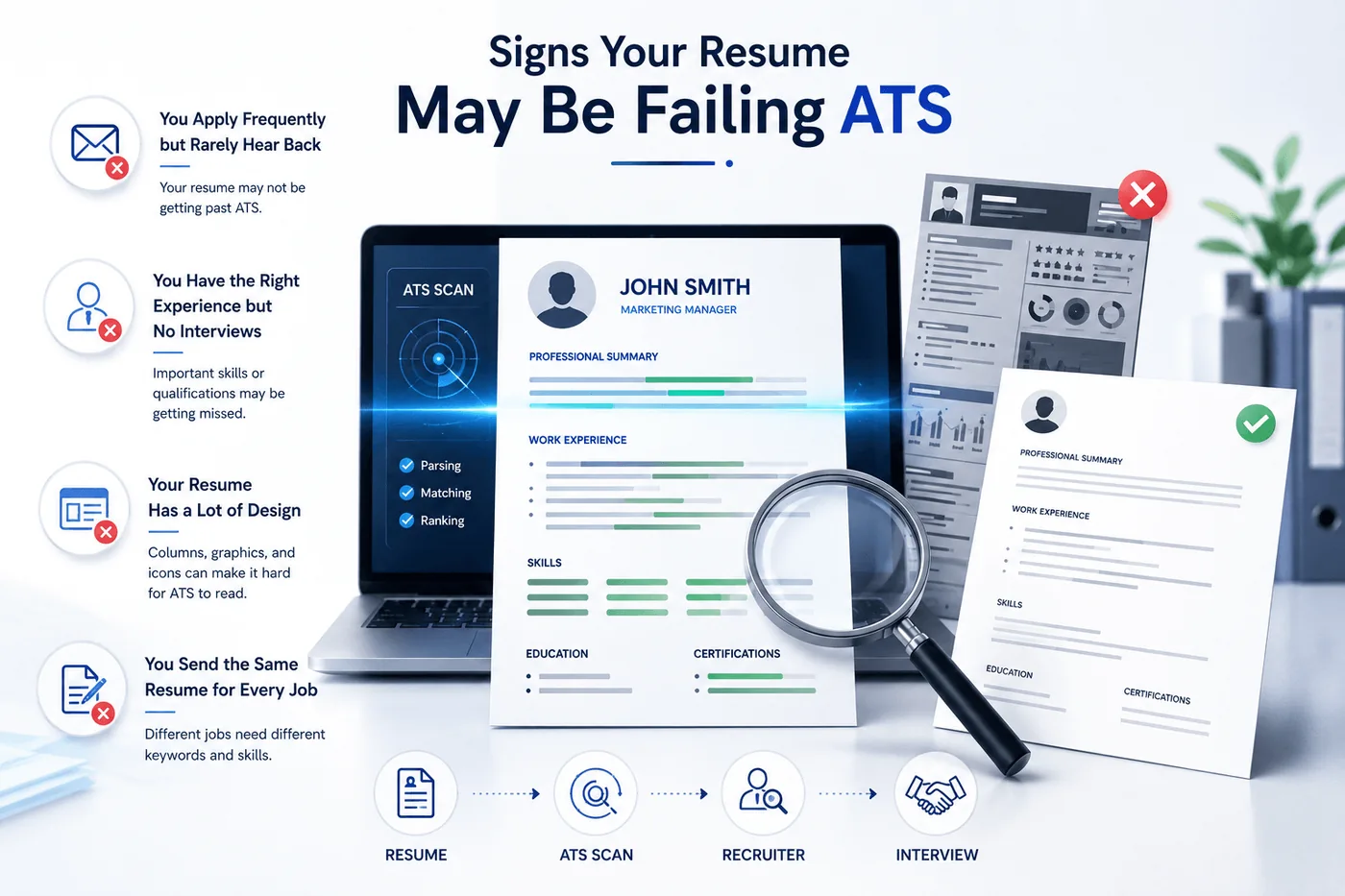
Not sure if your resume is passing the ATS? There are a few things you can look at. If you're seeing the same problems with your applications again and again, your resume may need some changes.
Here are some common signs to watch for.
You Apply Frequently but Rarely Hear Back
You find jobs that match your experience. You apply. Then you hear nothing. If this keeps happening, take a closer look at your resume. Check if you're using the right keywords and whether your resume matches the job you're applying for.
You Have the Right Experience but No Interviews
You meet the job requirements. You have the skills. You have the experience. Still, you're not getting interview calls.
Check your resume against the job description. Are the important skills and qualifications mentioned clearly? Can the ATS easily find them?
Your Resume Has a Lot of Design
Does your resume have columns, graphics, icons, tables, or text boxes? These may make your resume look good, but they can make it harder for an ATS to read. Try a simple, clean format and see if your resume becomes easier to read.
You Send the Same Resume for Every Job
You may be applying for the same type of role, but that doesn't mean every company wants the same thing. One company may want SEO experience. Another may want paid advertising. Another may focus on team management.
If your resume stays exactly the same, you may be missing the keywords and skills that matter for each job. Take a few minutes to change your resume for each application. It can make a big difference.
How to Make Your Resume ATS-Friendly
Now that you know what can go wrong, it's time to fix it.
Making your resume ATS-friendly doesn't mean adding more design or filling it with keywords. It means making your resume clear, relevant, and easy to read. You want the ATS to find your information easily and the recruiter to understand your experience quickly.
Here are some simple ways to write a resume that gets you an interview and is ATS-friendly.
1. Read the Job Description Carefully
The job description tells you what the employer is looking for.
Before changing your resume, read the job posting from start to finish. Look for the skills, tools, qualifications, and experience mentioned by the employer.
Pay attention to:
- Required skills
- Preferred skills
- Software and tools
- Certifications
- Education requirements
- Job responsibilities
- Industry terms
If you have the skills mentioned in the job description, include them in your resume. Don't add something you haven't worked with just to match the job.
2. Use a Clean Resume Format
Your resume doesn't need a complicated design to look professional. A simple layout is often easier for an ATS to read. It also helps recruiters find your information quickly.
Keep these things in mind:
- Use a single-column layout.
- Use clear section headings.
- Choose a simple, professional font.
- Keep your spacing consistent.
- Avoid unnecessary graphics and icons.
- Don't put important information inside text boxes.
Your goal is to make every important detail easy to find.
3. Tailor Your Resume for Each Job
Don't send the exact same resume to every employer. Take a few minutes to compare your resume with the job description. Then update the parts that matter most.
You can change:
- Your Professional Summary
- Skills
- Keywords
- Relevant work experience
- Achievement bullet points
You don't have to rewrite your entire resume every time.
For example, if one job asks for SEO and content marketing, highlight those skills. If another asks for PPC and Google Ads, focus on your experience with those instead.
A small amount of customization can make your resume a much better match for the job.
4. Focus on Your Achievements
Don't only tell recruiters what you were responsible for. Show them what you achieved.
Compare these two examples:
Weak:
"Responsible for managing customer accounts."
Better:
"Managed 80+ customer accounts and improved retention by 24%."
The second example gives the recruiter something they can measure. Whenever possible, add numbers to your achievements. You can mention:
- Revenue
- Sales
- Cost savings
- Team size
- Customer growth
- Time saved
- Performance improvements
Numbers make your experience clearer and more convincing.
5. Keep Your Keywords Natural
Keywords are important, but don't force them into every part of your resume. Use a keyword when it genuinely describes your experience.
For example, if you have experience with Salesforce, mention it in your Skills section. If you used Salesforce in your previous role, mention it in your work experience too.
You don't need to repeat "Salesforce" in every bullet point.
Before submitting your resume, read it once as a recruiter would. If the keywords fit naturally, you're on the right track. Your resume should be written for the ATS, but it should still sound natural to a person.
When Should You Hire a Professional Resume Writer?
You can fix minor errors in your resume; you may even make your resume ATS-friendly by up to 40% to 50%. However, making a resume 100% ATS-friendly is not that easy and requires professional skills and CV knowledge.
That’s why many job seekers hire a professional resume writer.
A professional resume writer can be especially helpful if you're:
- Not getting interview calls despite applying regularly.
- Moving into a new industry.
- Changing careers.
- Applying for senior or executive positions.
- Returning to work after a career break.
- Applying for jobs internationally.
- Unsure how to present your achievements.
- Struggling to tailor your resume for different roles.
A professional writer looks beyond formatting.
They help identify your strongest achievements, position your experience, use relevant industry language, and create a resume that represents your career accurately.
At Enhance Resume, our professional resume writers create personalized, ATS-friendly resumes for different career stages and industries. We focus on your experience, career goals, target roles, and achievements rather than forcing your information into a generic template.
The goal isn't simply to make your resume pass an ATS. It's to make your resume worth reading once a recruiter opens it.
Final Thoughts
Your resume needs to do two things. It needs to get through the ATS and catch the recruiter's attention.
Keep your resume simple. Use the right keywords. Match your resume with the job. Most importantly, show what you have achieved in your previous jobs.
If you're finding this difficult, Enhance Resume can help. Our professional resume writers create ATS-friendly resumes based on your experience and the job you want.
We work with fresh graduates, experienced professionals, managers, and executives.
Need a better resume? Let Enhance Resume help you create one.
FAQs
Why does ATS reject resumes?
The Application Tracking Software (ATS) can reject your resume for many reasons. For example, your resume may be missing keywords. There might be grammatical or formatting errors. You might have missed adding important skills or used unclear headings. These issues can make it harder for the ATS system to read and match your resume.
What resume format is best for ATS?
A simple reverse-chronological format is usually the best format for ATS. The reverse chronological resume gets shortlisted most by the ATS. Use standard headings, one column, readable fonts, clear spacing, and simple formatting. Avoid unnecessary graphics, tables, and text boxes.
Can ATS read PDF resumes?
Yes, ATS can read PDF resumes. However, some systems may handle resume files differently. Always check the job posting and submit your resume in the requested format by the hiring manager.
How do I know if my resume is ATS-friendly?
To know if your resume is ATS-friendly, check your resume for simple formatting, standard headings, relevant keywords, and clear sections. You can also use an ATS resume checker, but don't depend only on its score. Your resume should also be easy for a recruiter to read.
Should I use the same resume for every job?
No, your resume should be modified for each job. Update your summary, skills, keywords, and relevant experience based on what the employer mentions in the job description. Even the same job title can have different requirements at different companies.
How many keywords should an ATS resume have?
There is no fixed number of keywords for an ATS resume. Use the important terms from the job description that match your experience. Avoid repeating the same keywords unnecessarily. Focus on using the right keywords instead of using too many.
Can a professional resume writer improve ATS compatibility?
Yes. A professional resume writer can improve your resume's format, keywords, structure, and content. Enhance Resume can create an ATS-friendly resume tailored to your experience, industry, and target job.
← Back to all articles